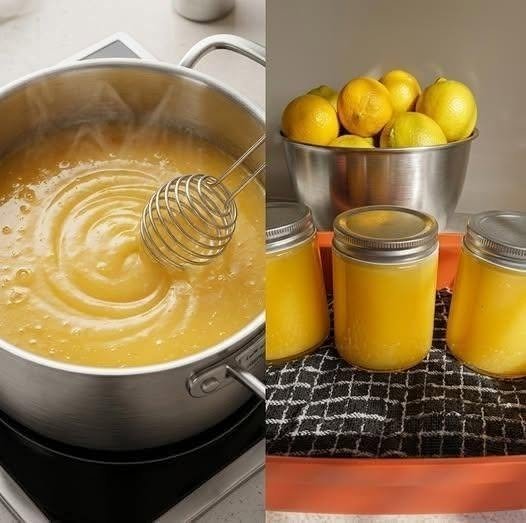

Ingredients
- 4 large egg yolks
- 2 whole large eggs
- 3/4 cup granulated sugar
- 1/2 cup freshly squeezed lemon juice
- 1 tablespoon finely grated lemon zest
- 1/2 cup unsalted butter, cut into small pieces
- 1 teaspoon vanilla extract
- Pinch of salt
Equipment
- Medium heatproof bowl
- Whisk
- Fine-mesh strainer
- Medium saucepan
- Rubber spatula
- Clean glass jar or container
Step 1: Prepare the Lemons
Start by washing the lemons well and drying them with a clean towel. Since the recipe uses lemon zest, it is best to use fresh lemons.
Finely grate the yellow outer part of the lemon peel. Avoid grating too deeply into the white layer underneath because the white pith can taste bitter.
After zesting the lemons, cut them in half and squeeze out the juice. Freshly squeezed lemon juice gives the curd a much brighter flavor than bottled lemon juice.
Measure out 1/2 cup of lemon juice and set it aside.
Step 2: Combine the Eggs and Sugar
Place the egg yolks, whole eggs, and granulated sugar into a medium heatproof bowl.
Whisk everything together until the mixture becomes smooth and slightly lighter in color.
There is no need to whip the eggs heavily. The goal is simply to combine the eggs and sugar evenly.
Step 3: Add the Lemon
Add the freshly squeezed lemon juice and grated lemon zest to the egg mixture.
Add a small pinch of salt as well.
Whisk everything together until the mixture is completely combined.
At this stage, the mixture will be quite thin. That is completely normal.
Step 4: Cook the Lemon Curd
Pour the mixture into a medium saucepan.
Place the saucepan over low to medium-low heat.
Cook the mixture gently, stirring constantly with a rubber spatula or whisk.
It is important not to use very high heat. Gentle cooking allows the eggs to thicken without scrambling.
Continue stirring, making sure to scrape around the bottom and edges of the pan.
After several minutes, the mixture will gradually become thicker.
Step 5: Check the Consistency
The lemon curd is ready when it is thick enough to coat the back of a spoon.
Another simple test is to run your finger through the curd on the back of the spoon. If the line remains visible instead of immediately filling in, the curd is thick enough.
Do not worry if the curd seems slightly thinner than you expected while it is hot. It will become noticeably thicker as it cools.
Step 6: Add the Butter
Remove the saucepan from the heat.
Add the butter pieces a few at a time.
Stir after each addition until the butter completely melts into the warm lemon curd.
Continue until all the butter has been incorporated.
The butter gives the curd its smooth, creamy texture and balances the sharpness of the lemon.
Step 7: Add Vanilla
Stir in the vanilla extract.
Vanilla is optional, but a small amount gives the lemon curd a softer and more rounded flavor.
Mix until completely incorporated.
Step 8: Strain the Curd
Place a fine-mesh strainer over a clean bowl.
Pour the warm lemon curd through the strainer.
Use a rubber spatula to gently push the curd through.
Straining removes any tiny pieces of cooked egg and excess zest, leaving you with an exceptionally smooth curd.
This step is especially useful if you want a silky texture for cakes, tarts, or pastries.
Step 9: Cool the Lemon Curd
Transfer the strained curd to a clean glass jar or container.
Allow it to cool for a short time at room temperature.
Once it is no longer very hot, cover the surface and place it in the refrigerator.
The curd will continue to thicken as it chills.
How to Serve Lemon Curd
There are many delicious ways to use homemade lemon curd.
Spread it over warm toast for a bright breakfast treat. Spoon it onto pancakes or waffles instead of traditional syrup. It is also wonderful with scones, biscuits, English muffins, or fresh berries.
For dessert, use lemon curd between cake layers or spread it over cupcakes. You can also spoon it into tart shells and top it with whipped cream.
Another easy idea is to layer lemon curd with plain or vanilla yogurt and fresh fruit to make a simple dessert parfait.
Lemon Curd for Cakes
Lemon curd makes an excellent cake filling.
For a simple lemon cake, bake two layers of your favorite sponge cake. Allow them to cool completely, then spread a layer of lemon curd between the cakes.
You can add whipped cream or buttercream around the outside.
The tart lemon filling provides a refreshing contrast to the sweetness of the cake.
Lemon Curd for Tarts
Lemon curd can also be used as a tart filling.
Prepare or purchase a baked tart shell and allow it to cool completely. Spoon the chilled lemon curd into the shell and smooth the surface.
Refrigerate until firm.
You can decorate the tart with whipped cream, fresh berries, thin lemon slices, or a light dusting of powdered sugar.
Tips for Perfect Lemon Curd
Use Fresh Lemons
Fresh lemon juice gives the curd the best flavor. Choose lemons that feel firm and juicy.
Keep the Heat Gentle
High heat can cause the eggs to cook too quickly. Low to medium-low heat gives you better control.
Stir Constantly
Continuous stirring helps the curd cook evenly and prevents the mixture from sticking to the bottom of the saucepan.
Do Not Overcook
Once the curd has thickened enough to coat the back of a spoon, remove it from the heat.
Remember that it will become thicker as it cools.
Strain for Smoothness
Straining is optional, but it produces an especially smooth and professional texture.
Use Unsalted Butter
Unsalted butter allows you to control the amount of salt in the recipe.
How to Store Lemon Curd
Keep homemade lemon curd in a clean, airtight container in the refrigerator.
It is best enjoyed within about 1 to 2 weeks when properly refrigerated.
Always use a clean spoon when serving the curd to help maintain freshness.
For longer storage, lemon curd can also be frozen in a suitable freezer-safe container. Leave some space at the top because the curd can expand slightly when frozen.
Thaw frozen lemon curd in the refrigerator and stir it well before using.
Can You Make Lemon Curd Less Sweet?
Yes. If you prefer a sharper lemon flavor, you can slightly reduce the sugar.
However, sugar does more than provide sweetness. It also helps balance the acidity of the lemon and contributes to the final texture.
For the best consistency, avoid making a dramatic reduction in the sugar on your first attempt.
Can You Make It More Lemon-Flavored?
For a stronger lemon flavor, use additional finely grated zest rather than adding a large amount of extra lemon juice.
Lemon zest contains flavorful oils that provide a strong citrus aroma without adding as much liquid.
Make sure to grate only the yellow outer peel and avoid the bitter white pith.
Why Did My Lemon Curd Become Lumpy?
Lumpy curd usually means the eggs cooked too quickly.
The most important prevention is gentle heat and constant stirring.
If your curd has only a few small lumps, passing it through a fine-mesh strainer while warm can often give it a much smoother texture.
Why Is My Lemon Curd Too Thin?
If the curd is still warm, give it time to cool before deciding that it is too thin.
Lemon curd thickens considerably as it chills.
If it remains too thin after completely cooling, it may not have been cooked long enough for the eggs to thicken properly.
Why Is My Lemon Curd Too Thick?
Lemon curd can become quite firm if it is cooked for too long.
If it is slightly too thick, allow it to warm gently and whisk it until smooth.
For future batches, remove the curd from the heat as soon as it reaches the correct coating consistency.
Flavor Variations
Raspberry Lemon Curd
Serve lemon curd with fresh raspberries for a sweet-tart combination.
Blueberry Lemon Curd
Lemon and blueberry pair beautifully. Use lemon curd as a filling for blueberry muffins, cakes, or pastries.
Coconut Lemon Curd
Serve lemon curd with coconut cake or toasted coconut for a tropical-style dessert.
Ginger Lemon Curd
A small amount of finely grated fresh ginger can add a warm, slightly spicy note.
Strawberry Lemon Dessert
Layer lemon curd with sliced strawberries and whipped cream for an easy dessert.
Recipe Summary
Prep Time: 10 minutes
Cook Time: 8–12 minutes
Cooling Time: About 1 hour
Total Time: About 1 hour 25 minutes
Yield: Approximately 1 1/2 cups
Ingredients
- 4 egg yolks
- 2 whole eggs
- 3/4 cup sugar
- 1/2 cup fresh lemon juice
- 1 tablespoon lemon zest
- 1/2 cup unsalted butter
- 1 teaspoon vanilla
- Pinch of salt
Quick Method
- Zest and juice the lemons.
- Whisk eggs and sugar together.
- Add lemon juice, zest, and salt.
- Cook gently while stirring constantly.
- Continue until the mixture coats the back of a spoon.
- Remove from the heat.
- Whisk in the butter.
- Add vanilla.
- Strain for a smooth texture.
- Cool and refrigerate until thickened.
Final Thoughts
Homemade lemon curd is a wonderfully versatile recipe that can be prepared with simple ingredients. Its creamy texture and fresh citrus flavor make it useful for breakfast, baking, and desserts.
Once you make your own lemon curd, you can use it in countless ways. Spread it on toast, spoon it over pancakes, layer it into cakes, fill pastries, serve it with berries, or simply enjoy a small spoonful when you want something bright and lemony.
The key to success is gentle cooking, constant stirring, and patience. Allow the curd to cool completely before judging its final texture. With fresh lemons, good-quality butter, and a little care, you can make a smooth and delicious lemon curd right in your own kitchen.